
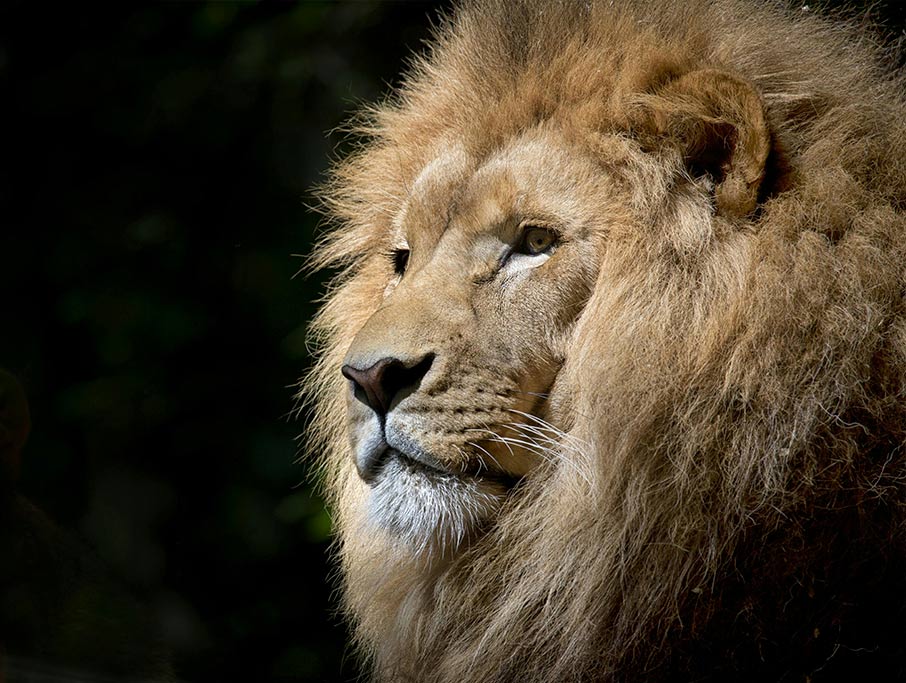

Historically, lions are the kings of the jungle. Although this expression may be confusing – they live on grasslands and plains – the word “jungle” comes from the Hindi word “jangle”, which refers to any natural area that has not been invaded by humans. They once lived in many parts of Asia, North Africa and the Balkans, but are now mostly found in sub-Saharan Africa and some regions of the Congo Basin.
The lion’s beauty, strength and ferocity have made it the protagonist of many works of art, films and cultural symbols. It is also the largest felid in the world, along with the tiger.
The males are distinguished from the females by their impressive manes, which come in various shades of blonde and brown and darken over time. The thicker the mane, the more attractive the lion is to females. Cubs, on the other hand, are born with blue eyes and a brownish pattern in their fur, similar to that of leopards. Over time, the eyes become hazel ochre and the coat pattern disappears.
Like domestic cats, lions are lazy animals that spend most of the day sleeping. They are most active at night, taking advantage of the darkness to hunt. However, it is the lionesses that usually hunt in groups, with a perfectly thought out and developed strategy.
Lion prides, which are becoming smaller and more dispersed, are made up of several related females, their cubs and a few adult males. Cubs often leave their families to form their own pride, which is likely to be led by another male and will have to compete for leadership.
Due to increasing habitat loss, prey scarcity and human conflict, the lion population has halved in the last 25 years. As visitors to their domain, we must respect this remarkable animal and its environment.